
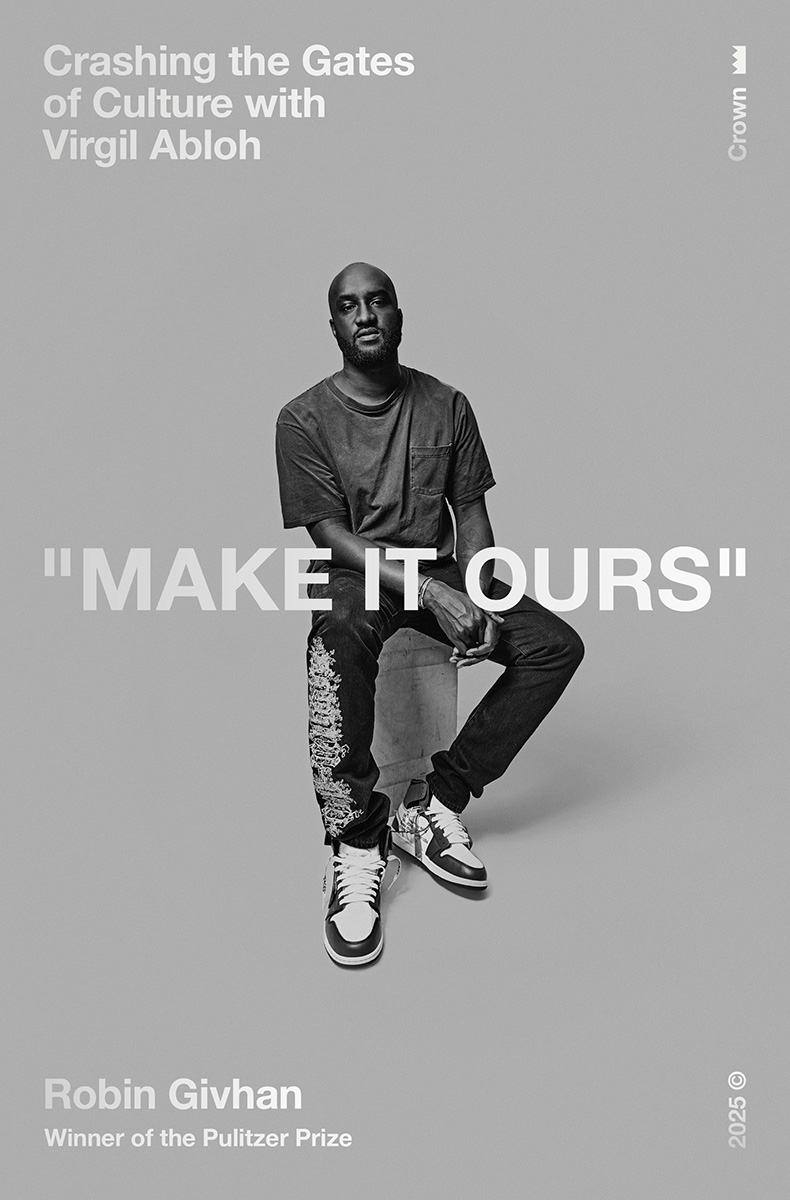
Photo: Courtesy of Penguin Random House
Virgil Abloh is considered one of the most prolific figures in fashion history, which is impressive for a designer who met an untimely passing when he was in his early 40s. What Abloh managed to accomplish during his time on Earth and in the fashion industry is still discussed several years after his death. An exploration and written retrospective of his career, “Make it Ours,” written by veteran fashion critic Robin Givhan, was recently published. The biography, which is already receiving critical acclaim, explores fashion and race, taste and exclusivity, and the genius that made Abloh a man the fashion industry would come to know and love.
Abloh didn’t start as a celebrated fashion designer with people knocking down the doors to attend his fashion shows, though. Born in Rockford, Illinois, his mother, a seamstress, taught him how to sew, although Abloh did not follow a traditional path to becoming a designer. He received a bachelor’s degree in civil engineering from the University of Wisconsin-Madison, then went on to earn a Master of Architecture from the Illinois Institute of Technology. However, it was at IIT where his love of fashion began to spark.
A building on campus designed by Rem Koolhaas, who also worked on collections for Prada, inspired Abloh to start learning more about fashion. He began designing T-shirts and writing for a fashion blog. A chance encounter with Kanye West eventually led both of them to intern at Fendi, one of the most acclaimed brands under the luxury conglomerate LVMH Moët Hennessy Louis Vuitton.
Abloh and West started a collaborative partnership. Eventually, West appointed Abloh as the creative director of his creative agency, Donda. In 2013, Abloh founded the brand that would later make him a household name, Off-White.
Off-White became one of the hottest labels in the world, leading to Abloh forming partnerships with Ikea and collaborating with Nike. When Louis Vuitton sought a new menswear director, they made history by selecting Abloh, making him the first Black menswear director in LVMH Möet Hennessy Louis Vuitton.
Abloh was more than a visionary; he was a once-in-a-lifetime talent. Beyond fashion, he also regularly worked with Japanese artist Takashi Murakami, with Abloh even receiving a solo art show in Murakami’s Kaikai Kiki art gallery. He was also a DJ, playing at venues around the world. There was so little the man couldn’t do.
With talent so rare, the question is, can the current fashion ecosystem ever produce another talent like Virgil Abloh? Abloh had no formal design training, yet climbed through the ranks of fashion, expanding his creative endeavors to art and music. Truly talented multi-hyphenates are a dime a dozen, but the industry still has many great designers who don’t count Parsons, FIT, or Central Saint Martins on their resumes.
Colm Dillane, founder and designer of KidSuper, was a mathematics major at NYU. Nicolas Ghesquière, creative director of Louis Vuitton, turned down a place at art school to work as Jean-Paul Gaultier’s assistant. Raf Simons, co-creative director of Prada, studied furniture design. Even looking at more historic examples, the legendary Coco Chanel had no formal fashion education, and neither did Karl Lagerfeld who would later turn Chanel into a multi-billion-dollar brand as its artistic director.
One of the big problems any young designer trying to follow in Virgil Abloh’s steps faces is that so much of the business model that helped give young brands a leg up is not the same. Off-White had financial backing from New Guards Group, an Italian luxury fashion production and distribution holding company. The company also provided financial support to other brands, including Palm Angels and Heron Preston.
Unfortunately for young brands seeking funding, New Guards Group has experienced multiple changes in ownership through acquisitions and has faced financial struggles. In August 2019, the company was acquired by Farfetch. Following a series of financial challenges, including delisting from the stock market and approaching Chapter 11 bankruptcy, Farfetch was eventually purchased by South Korean e-commerce firm Coupang. In November 2024, New Guards restructured under Italian bankruptcy protection in an effort to avoid full bankruptcy. Needless to say, they aren’t investing money in emerging brands.
The other major issue is that the department store model doesn’t function the same way either. Saks announced it would change its payment terms for vendors, with vendors now being paid on a 90-day schedule. For a young designer incurring high costs to have inventory at Saks, 90 days is a long time to go without receiving payment.
Under the current fashion ecosystem, the high demand for the number of collections produced per year is enough to break even the most talented designers. When Abloh was designing for both Off-White and Louis Vuitton, that left him with spring/summer, fall/winter, pre-fall, and resort collections for both brands. The one living designer we have enduring that hamster wheel is Jonathan Anderson, who upon taking over the creative reins at Dior, is now responsible for 16 collections per year between Dior, his eponymous label J.W. Anderson, and his collaboration with Uniqlo.
While Anderson is willing to endure that kind of pressure, most designers are not. Alexander Wang left Balenciaga after three years, reportedly burnt out from handling his namesake brand and the demands of a historic global luxury label. Toward the end of his tenure at Dior, Raf Simons was producing six collections a year for the brand, in addition to still doing seasonal collections for his namesake brand. After leaving Dior, he moved on to Calvin Klein, where the pace seemed slower. Post-Calvin Klein, he became co-creative director of Prada and shuttered his own line. Abloh’s successor at Louis Vuitton, Pharrell Williams, is best known to the public as a musician and music producer, but doesn’t wear the contemporary artist hat like Abloh did with Murakami.
Anderson is one of the few designers who seems to want the stress of dealing with multiple brands. This type of behavior was only ever seen in Lagerfeld, who oversaw Chanel, Fendi, and his namesake brand. While most designers dream of having their brand in addition to landing one of those big creative director positions, the demands of wearing that many hats are often beyond even some of the most talented designers.
One thing Givhan also noted in her biography of Abloh is that he was notoriously inclusive in an industry that often prided itself on exclusion. To the chagrin of those he hired for his public relations during Fashion Week, Abloh would meet people out during Paris Fashion Week and connect with them, then decide to invite them to his runway shows, like it was a casual event rather than an invite-only situation where the guest list was finalized weeks ago.
Although fashion has become much more democratized in some ways, from social media giving consumers behind-the-scenes access and insight into the world they’ve built to luxury brands becoming more accessible via resale sites like Grailed and The Real Real, there has arguably been a return to the culture of exclusion in fashion that is running rampant.
After the George Floyd protests in 2021, the fashion industry took a close look at itself and began fostering diversity, equity, and inclusion programs to help discover and nurture more BIPOC talent. In 2025, many companies have started eliminating their DEI programs, arguably setting the fashion industry back an entire era in terms of racial progress. Post-COVID-19, designers have started hosting more intimate runway shows again. New York Fashion Week used to see rows on top of rows of guests, in addition to standing room. Now, runway shows are often limited to 150 guests with little to no standing room. Abloh flouted the airs of elitism in the fashion industry which are still in full effect.
As the industry still mourns the loss of Abloh several years later, we also quietly accept that he was a once-in-a-lifetime talent, the likes of which will never be seen again. R.I.P. to one of the greatest designers to ever do it, with a legacy that is certain to inspire generations across multiple disciplines from art to design.